AI adoption skyrocketed in 2026. But few teams can prove its effectiveness.
Five research teams published 2026 numbers on AI adoption for go-to-market teams. They agree on the part that matters: adoption is nearly universal. Between 91 and 96 percent of marketing and GTM teams now use AI in the work. The share that can point to a return is moving the other way.
Jasper's State of AI in Marketing survey ran two years running, and between them the share of marketers who could demonstrate a return on AI fell from 49 percent to 41. In the same two-year span, adoption climbed past 90 percent. AI tool usage grew faster than most organizations' ability to prove it had a positive impact. That gap is the subject here.
A marketing team on the same Claude or ChatGPT plan as a team at another company can get a completely different result, and a completely different return. The difference is the operations layer the AI runs on. I built a diagnostic that measures that layer for go-to-market teams after the same gap kept showing up across engagements, and it is part of why my co-founder and I started Aligned Intelligence. What follows is the research on that gap, plus one representative result from the diagnostic.
TL;DR
- Between 91 and 96 percent of marketing and GTM teams use AI in 2026. The surveys converge there.
- In the one survey that measured the same point twice, the share able to demonstrate a return dropped year over year, from 49 percent to 41.
- The proof rate fell because the standard rose. Time saved counted as ROI last year. Leadership now wants revenue or margin, and most teams instrumented for the first bar.
- The reports name the same root cause: the operations layer under the AI. Data that needs a rebuild before anyone trusts it, routing nobody watches, no single owner.
- That layer has barely moved. One benchmark has process and operations as its weakest capability, unchanged in rank for three years.
- A team can score high on AI use and low on the foundation it runs on. That combination is where the wasted spend collects.
- The fix runs in order: the data the automation reads from, then one accountable owner, then a metric that is not hours saved.
Adoption increased while proof of return dropped
Start with Jasper, since it tracked the same teams two years running. The slide from 49 to 41 percent on provable ROI happened while adoption went from 63 to 91. Break the 41 out by seniority and it separates cleanly: 61 percent of CMOs say they can show a return, against 33 percent of managers and 12 percent of individual contributors. The people closest to the work are the least able to prove it paid off, which points at something structural rather than a skills gap.
The Content Marketing Institute's 2026 B2B research reads it as a plateau. Adoption is at 95 percent. The share seeing significant performance gains is at 39. When almost every team has the same capability, having it stops explaining who is pulling ahead.
Demand Gen Report puts usage at 96 percent across more than 300 marketers, with efficiency named as the primary benefit. Growth Unhinged's 2026 State of AI for GTM is blunter still: 53 percent of GTM leaders report little to no impact. The figure moves by survey. The direction holds. Most teams are running AI in production without a number that says it works.
Why the proof rate fell while usage climbed
The bar moved. A year ago, saving time was a complete answer. Jasper's data shows most teams built their measurement around it and stopped there: the most common ROI metric in use is hours saved by employees, at 57 percent, then reduced agency spend at 43. Growth outcomes, the conversion and revenue lift a CFO actually asks about, register for 29 percent.
So when finance starts asking what the AI line returned in pipeline or margin, most teams cannot answer in those terms. They have a time-savings story and a growing bill. Wider adoption also pulls the average down. When the whole market adopts, a smaller share of it counts as mature, and mature practitioners are the ones who can show returns. Jasper's CMO made that point directly about this year's drop.
Both of those are happening at once, which is why the proof rate can fall in a year when nothing about the technology got worse. What changed is the standard it is measured against and the size of the field being measured.
The operations layer gap
LeanData and LXA's 2026 benchmark of 201 senior B2B leaders is direct about where returns leak. Process and operations is the weakest capability they measure, and it has held that rank three years running. Their phrasing on the risk: layering AI on top of unmonitored routing accelerates lead leakage rather than fixing it.
Eighty-two percent of those leaders agree that clean data and reliable routing have to come before scaling AI. One in three have the systems to make that real. Half say they are confident in their AI governance readiness. Demand Gen Report has 18 percent naming incomplete data as their single biggest barrier to confident decisions, ahead of budget and headcount.
This was underfunded work before anyone had an AI budget. CRM hygiene, routing rules, process documentation. The automation now sitting on top of it magnifies every gap that got skipped.
What this looks like on one team
The diagnostic I built, a GTM AI Readiness Assessment for Aligned Intelligence, scores a team on five axes: data foundation, automation infrastructure, AI depth, ownership, and process maturity. Two of those axes place the team in one of four archetypes, based on the strength of the data underneath and the amount of build sitting on top.
A representative result:
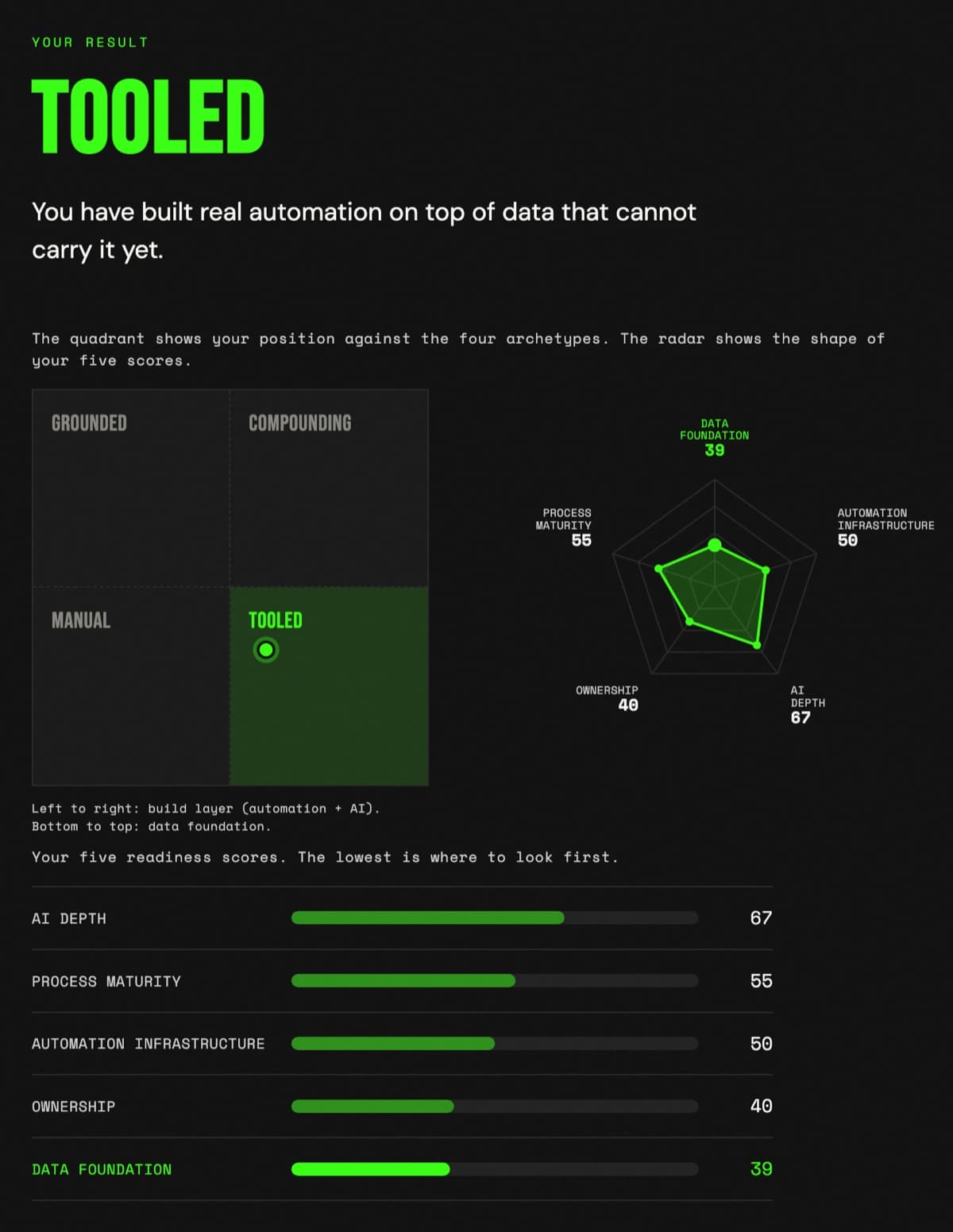
This team has genuine AI depth and genuine automation. Workflows run. People use assisted tools every day. Data foundation comes in at 39. The archetype for that pairing is Tooled, and it is the most common one the assessment returns. The tools work. The output is wrong often enough that people re-check it by hand, so the time the automation was meant to save never fully lands.
That is the 41-percent problem viewed at one team. The AI is deployed. The foundation it reads from cannot carry it, and the return stays on paper.
The tell: what you claim against what your answers imply
The assessment cross-checks answers instead of trusting a self-rating. It asks you to describe your CRM data, then a few screens later asks how long it would take to pull a deal-source breakdown for last month. Call the data healthy, then say that report takes a day or more, and it names the gap.
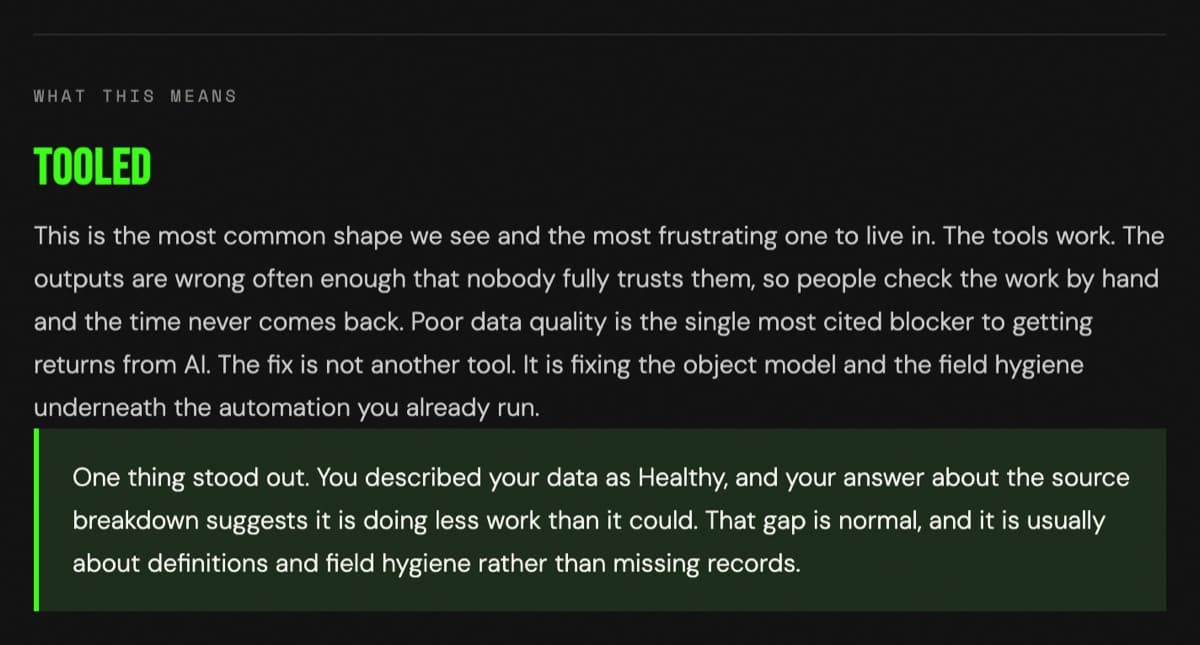
This is the seniority split from earlier in miniature. Teams grade their readiness by how much AI they have rolled out. The work grades them by what the AI returns. The two scores separate, and nobody sees the distance until a real measurement forces it.
Fix the layer everything else reads from
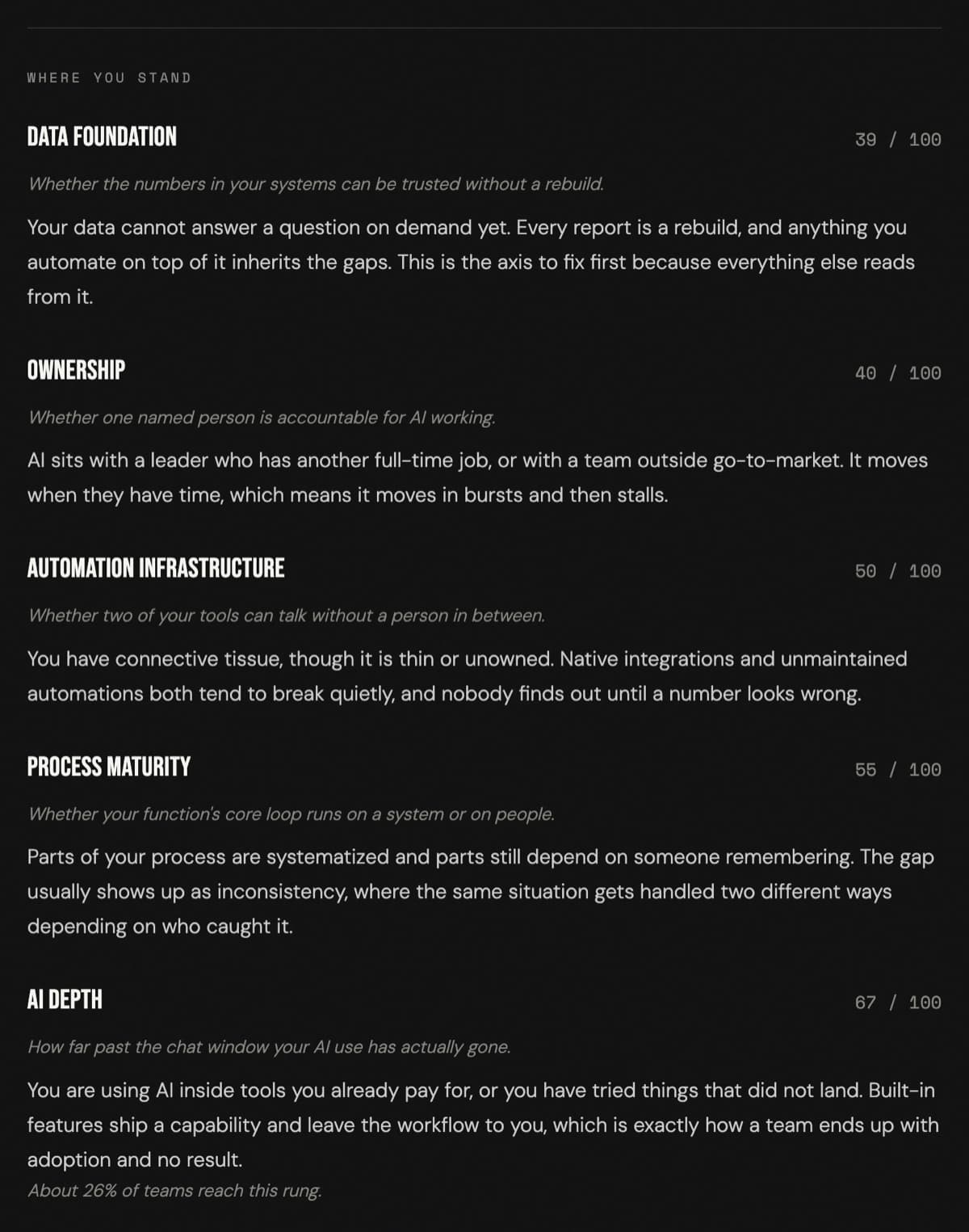
The axes report worst-first on purpose. Data foundation is almost always the one to fix ahead of anything else, because every workflow, every report, and every agent reads from it. The work is slow and unglamorous: agree on the definition of a qualified opportunity, check fill rates on fields in records created this quarter, decide which fields are load-bearing and hold the line on them.
When I put agentic workflows into demand gen at a Series A security company, they held up because of sequence. The Salesforce-to-HubSpot migration and the object-model cleanup came first. The agents went on data that was already trustworthy. I covered where the human checkpoint sits in that setup separately. The checkpoint only helps if the inputs are clean going in. The routing logic behind no lead left behind carries the same dependency.
Ownership is the second axis worth calling out. The ability to prove a return tracks with how mature a team's practice is, and maturity does not form without one person accountable for it. Not a working group. One name, even at a tenth of their week, holding one metric to move.
If you only do three things this quarter
- Write down your definition of a qualified opportunity, send it to two colleagues, and check whether all three of you agree.
- Name one person accountable for AI outcomes and hand them a single metric that is not hours saved.
- Find the automations nobody owns. They keep running after the process they served changed, and they quietly produce wrong numbers.
Where the returns actually show up
The teams getting a return are not on better models. Salesforce's 2026 State of Marketing, reported by MarketScale, found that teams running AI inside tightly scoped workflows rather than as a general content engine cut cost-per-lead by roughly 38 percent and booked more meetings per rep. Growth Unhinged profiles teams generating a quarter of their pipeline through AI prospecting built on general-purpose models, inexpensive tooling, and a large amount of internal context handed to the model.
The pattern under those results holds steady: narrow scope, clean inputs, one owner, and a tracked number leadership reads as a business outcome. The readiness data points at the same list from the other side.
The next 18 months
The adoption race is settled. Almost every team has AI in the stack. What sorts teams from here is whether the layer under the AI can hold its weight, and that layer is mostly CRM hygiene, routing discipline, and a name on the outcome. That work is slow and mostly invisible. It is also what separates the teams with a number from the teams with a bill.
Want a read on where your team's AI readiness stands?
- Take the GTM AI Readiness Assessment. About five minutes for your five-axis score, your archetype, and the one workflow to build first.
Common questions
Why can fewer marketers prove AI ROI in 2026 than in 2025?
Adoption rose and the standard for proof rose with it. Time saved counted last year. Leadership now expects revenue or margin impact, and most teams built their measurement around efficiency rather than growth. Jasper's survey recorded the shift, from 49 percent able to demonstrate a return down to 41.
Is AI adoption really near-universal in B2B?
Yes. Independent 2026 surveys from Jasper (91 percent), the Content Marketing Institute (95 percent), and Demand Gen Report (96 percent) all land in that range.
What is the biggest blocker to getting a return on AI?
The data and process layer underneath it. Multiple 2026 reports point to data quality and unmonitored routing as the main constraint, ahead of budget or model choice.
What does AI readiness actually measure?
Whether the operations layer can carry automation. That means trustworthy data, tools that pass information without a person in the middle, one named owner, and a core process that runs on a system rather than on someone remembering.
Should we pause AI projects until the data is clean?
Sequence them rather than pause. Fix the data a specific workflow depends on, build that one workflow, measure it, then expand. Teams that start with one or two focused workflows report better returns than teams that start with seven.
What is the Tooled archetype?
A team with working automation built on data that cannot support it yet. The output is untrustworthy often enough that people verify by hand, so the promised time savings never arrives. It is the most common result the readiness assessment returns.
Keep reading
How to Nail Your First 90 Days as a Channel Marketing Manager
Channel marketing managers succeed by making partners successful, not by running good campaigns of their own, a throughline confirmed across 30+ real job postings. Here's a 30/60/90 day plan built around that, adaptable across industries.
No Lead Left Behind: A Demand Gen Routing Framework for Any Business
A working system for routing every lead, however it shows up, to the exact next step it has earned. Built for B2B security, but the shape holds for B2C too.
Want to talk through your AI readiness result?
Reach out and we'll walk through your score, the gaps that matter most, and the first workflow worth building.